Wondering where to start reading the Bible? Read on! This post includes affiliate links – see legal info here.
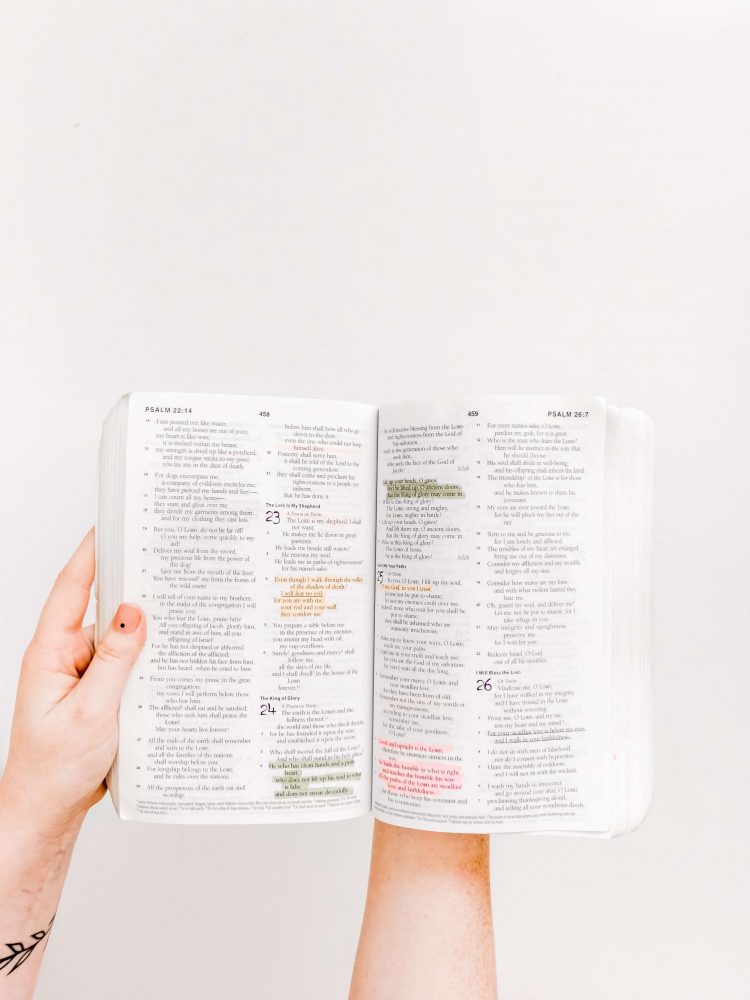
There are many reasons why you might be looking to start reading the Bible.
You might be going through a season of transition or a scary, uncertain time. (Pandemic, anyone?) And you may be looking to find purpose or wisdom in the midst of chaos.
Maybe you’ve seen so many varied opinions on Christianity that you want to study out the truth for yourself. Or maybe you’re studying religions and Christianity is on your list.
All are absolutely fair and valid reasons. Whatever your goal, the Bible – one of the oldest and still one of the top-selling books in the world – is the right place to start.
Unfortunately, there are also many reasons why you might drop the idea.
If you haven’t read it much, the Bible can feel kind of overwhelming.
First of all, the book is gigantic. Second, it comes in all kinds of versions, some of which include a ton of words we don’t use every day. Which one do you even choose?
Third, how do you know where to start reading the Bible?
Take a break from browsing Bibles online, and take a deep breath instead.
I so relate. Even though I grew up hearing the Word, I’ve had to study the Bible over and over again to make my faith and beliefs my own.
One thing I know for sure: don’t dig into the Bible without help. Bible reading and study has been both a solo and team effort in my life for many years, whether with sermons, accountability partners, small groups, personal studies, in counseling sessions, reading plans, or other kinds of teachings.
You don’t have to do it alone. There are many Bible resources to help you feel confident as you dig into the Bible. (Thanks for starting here with me.)
Here are my best tips for where to start reading the Bible:

First, find a good translation.
All Bibles in any language are translated from the original Hebrew (Old Testament), Aramaic and Greek (New Testament).
My favorite, go-to translation is the New International Version. Out of all the translations, this one strikes a good balance of getting to the original meaning of the text, while also being readable in our current day. I also like the English Standard Version. (This journaling Bible is a similar one to one I have, and it’s nice for writing notes in the margins or adding your own pretty decorations.)
The King James Version is more challenging, even the new version, containing a lot of the words that aren’t common in our vernacular.
The Message version is more conversational, but doesn’t always get to the original intended meaning of the text as well as NIV, and might be worth waiting until you have more of a feel of one of the above versions.
And while the Amplified Version is great too, it takes word study and definitions to a new level, which can be a bit much to take in initially.
Next, choose a gospel.
It might sound odd, but you probably don’t want to start the Bible at the beginning. I know, I know. Hear me out.
The whole Bible, and the whole foundation of Christianity points to Jesus Christ. Start with him to better understand the direction of the rest of the Bible.
Everything that comes before helps us understand our need for him. Everything that comes after helps us apply his teachings to our lives.
The gospels tell the story of Jesus from beginning to…to be continued, all told from different perspectives, with some slightly different content and focuses that bring together a fuller picture of Christ (so they’re all worth reading).
Which gospel to choose? Pick the one that works for you:
Matthew: A former-tax-collector-turned-apostle. He often points back to the Old Testament, and focused on the theme that Jesus is the Messiah as described in Old Testament scriptures.
Mark: A converted Gentile Christian and follower of one of the Apostles. He wrote his gospel based on someone else’s firsthand account, and focused on Jesus as a servant.
Luke: A converted Gentile Christian, physician and missionary along with Paul. He approaches his gospel in a very historical way, and also shows a lot of the human side of Jesus.
John: A Jewish apostle of Jesus sharing his firsthand account of his time spent with Jesus. John focuses on a lot of the “I am” scriptures that Jesus uses to identify himself and his character.
My vote goes to the book of John first, because it heavily emphasizes truth. But again – they’re all worth the read, and it doesn’t really matter which you start with.
Pray, or set an intention to have an open mind.
Psalm 119:18 NIV says, “Open my eyes, that I may behold wonderful things from Your law.”
You might be looking to start your spiritual journey with the Bible. Or you might just be looking at the Bible purely for research or academic reasons.
Either way, there’s no harm in praying or setting an intention to be open to the scriptures, for help in understanding them, and to have your eyes open to what they have to say.
Often we come into anything new we learn with a whole lifetime of perspective that’s already been taught to us. We might have some preconceived ideas or even feel the burn from past experiences. Remember to have an open heart and mind when it comes to approaching the Bible.
Take the challenge to live it out.
Again, you can have any number of reasons for wanting to read the Bible.
Hebrews 4:12 NIV says, “For the Word of God is living and active. Sharper than any double-edged sword, it penetrates even to dividing soul and spirit, joints and marrow; it judges the thoughts and attitudes of the heart.”
This is no ordinary book. It can absolutely change your perspective and life if you let it.
In John 8:31 NIV, Jesus says, “If you hold to my teaching, you are really my disciples. Then you will know the truth, and the truth will set you free.”
If you are seeking truth, try living it. See what happens in your life when you apply Jesus’s teachings.
From there, keep moving forward.
You could take the challenge to read all of the gospels, and piece together more of a picture of who Jesus is.
You might want to go into the book of Acts, where it tells what happened with the disciples and the church after Jesus was raised from the dead.
Maybe you’ll venture into some of the epistles, or letters of correspondence between the disciples and the churches. I like Hebrews, because it’s written to the Jews, reminding them that Jesus is who he claimed to be.
Also Romans, because it’s written to Gentile converts, calling them to leave their old ways behind and reminding them of their acceptance in God’s kingdom.
Maybe you’ll study more into Jesus’s life and the radical claims and calls that he made.
Maybe you’ll start to look into the Old Testament to better understand the background story of the Jews.
You might, at this point, pick up a study guide or reading plan, and get some direction for your next steps. (May I suggest: How to Read the Bible for All It’s Worth)
All that said, please – try to have an open heart and mind. And keep trying to live out Jesus’s teachings. They will amaze you in their simplicity, their heart, and their purpose.

If you’re starting on your faith journey:
Here are some encouraging verses to help you get started.
“The unfolding of your words gives light.” – Psalm 119:130 NIV
“From one man he made all nations, that they should inhabit the whole earth; and he marked out their appointed times in history and the boundaries of their lands. God did this so that they would seek him and perhaps reach out for him and find him, though he is not far from any one of us.” – Acts 17:26-27 NIV
“All scripture is God-breathed and is useful for teaching, rebuking, correcting and training in righteousness, so that the servant of God may be thoroughly equipped for every good work.” – 2 Timothy 3:16-17 NIV
“If any of you lacks wisdom, you should ask God, who gives generously to all without finding fault.” – James 1:5 NIV
“Ask and it will be given to you; seek and you will find; knock and the door will be open to you.” – Matthew 7:7 NIV
“Now the Berean Jews were of more noble character than those in Thessalonica, for they received the message with great eagerness and examined the Scriptures every day to see if what Paul said was true.” – Acts 17:11 NIV
How about you?
What questions do you have? Or if you have studied the Bible, what recommendations or tips do you have to pass on to someone just starting?
In case you’re interested – here’s a free women’s Bible study I put together for quarantine (or other difficult times); and here are other free women’s Bible studies online.
Photo Credit: all by Sincerely Media on Unsplash
Holy Bible, New International Version®, NIV® Copyright © 1973, 1978, 1984, 2011 by Biblica, Inc.® Used by permission. All rights reserved worldwide.





Leave a Reply