
Recently, I talked about 3 ways to start tackling insecurity.
Insecurity is a pattern in my life that is so frustrating to me. It involves a fear of what people think, feelings of unworthiness, and a focus on my shortcomings. Dealing with it has involved digging through old feelings and answering hard questions, with lots of help.
The ways I’m tackling insecurity as noted in the post are continuing to work for me. And you know what? All of them have to do with mindset shifts.
One of those shifts is speaking positive affirmations instead of giving in to lies.
To affirm means a few things:
- to state as fact; assert strongly and publicly
- to declare one’s support for; uphold; defend
- to accept or confirm the validity of
- offer emotional support or encouragement

It feels incredible when someone does this for you, right? When someone praises your hard work for the world to see, or when someone defends you in a conflict, or when they confirm something you were never sure about yourself, or they simply encourage you.
Why is it so hard to affirm ourselves?
Honestly, it STILL feels a little dorky to say things to myself like, “you can do this” or “you look beautiful”. I can feel embarrassed hearing those things from other people (even though it still feels good).
But you know what I say to myself all the time? “You’re a failure.” “You sound stupid.” “You can’t keep up.” “You look terrible.”
So, a) I’m still talking to myself either way. (Is that bad?)
And b) if I’m going to form opinions and conclusions about myself, why shouldn’t they be positive ones instead of negative?
Why can’t they reflect a positive overall opinion of myself instead of how I yucky feel in the moment?
Why self-affirmation?

First, does God think negatively about us?
No! We are “his chosen people, a royal priesthood, God’s special possessions” (1 Peter 2:9 NIV). We are children of God and co-heirs with Christ (Romans 8:16-17 NIV). Surely God does not think little of us.
Second, where should our thoughts be?
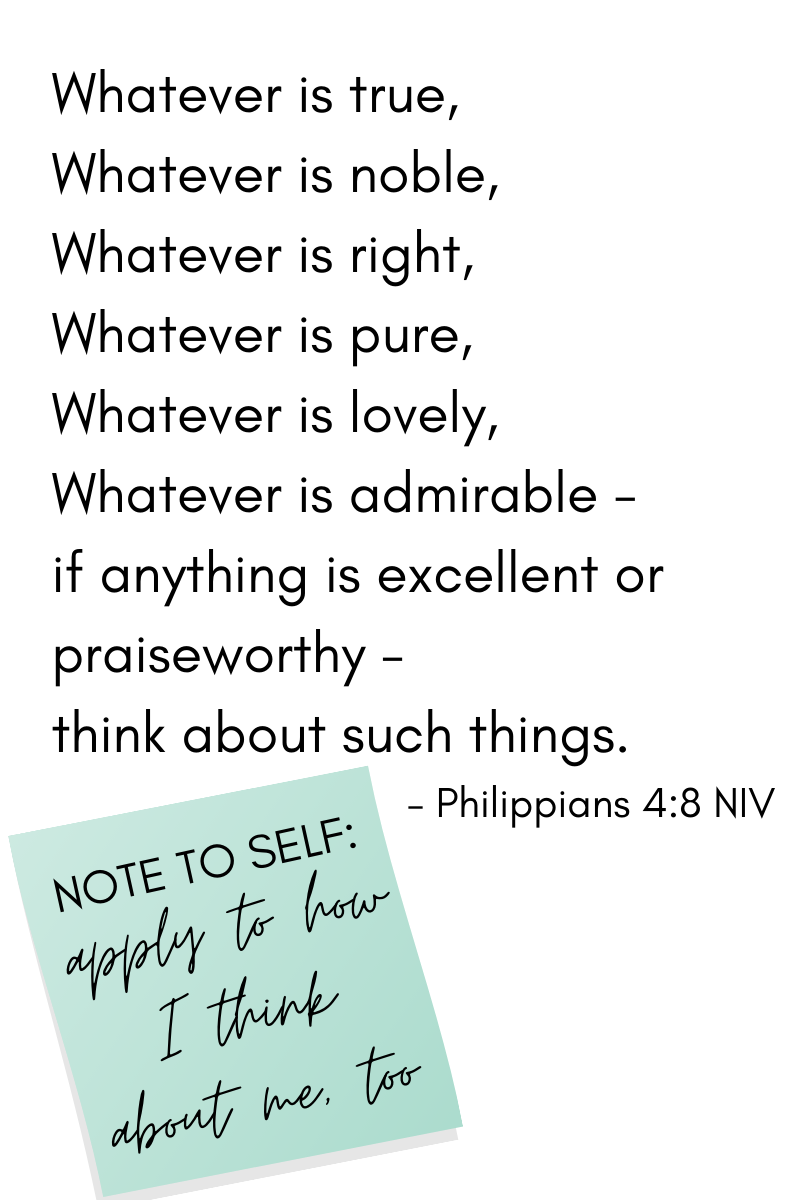
“Whatever is true, whatever is noble, whatever is right, whatever is pure, whatever is lovely, whatever is admirable – if anything is excellent or praiseworthy – think about such things.” (Philippians 4:8 NIV) This verse DOES NOT say “…except when it comes to yourself.”
It DOES say to “not think of yourself more highly than you ought” (Romans 12:3 NIV). And don’t forget about the “true” above. We should have a realistic perspective of ourselves, our choices, our sin, and our personalities.
But who are you to say that you – God’s incredible creation, God’s treasured possession, holy and dearly loved – are anything less than what God created you to be? Who are you to not see yourself through God’s eyes – that even though your sin is real, your value to God is real, too?
Finally, do we have control over our thoughts?
Yes! “…we take captive every thought and make it obedient to Christ,” (2 Corinthians 10:5 NIV) and “do not worry” (Matthew 6:25-34 NIV). These scriptures and more suggest that we can choose how and what we think.
Scientific research also backs up the power of the mind. Like this article from Harvard Health, which talks about the placebo effect, and how much it can improve physical conditions. Also, we can actually change the wiring that affects our perspective. Finally, we can choose to think differently about ourselves, which leads to a change in behavior and actions.
Here are some self-affirmations that you can consider in your own life:

How about you?
How would contemplating these self-affirmations change your beliefs, behavior, and actions?
Photo Credit:
1 – My own
2 – Andrew Rodef on Unsplash
Bible verses via BibleGateway.com: Holy Bible, New International Version®, NIV® Copyright ©1973, 1978, 1984, 2011 by Biblica, Inc.® Used by permission. All rights reserved worldwide.





Leave a Reply