Nav Social Icons

  • Skip to primary navigation
  • Skip to main content
  • Skip to primary sidebar
  • Skip to footer
  • Home
  • About
    • Beliefs
    • Privacy Policy
    • Disclosure
  • Blog
    • Faith
    • Marriage
    • Motherhood
    • Productivity
    • Relationships
    • Wellness
  • Resources
  • Podcast
  • Contact
  • Mobile Menu Widgets

    Connect

    Search

Jenn Schultz

Purpose, Worth and Wellness, Right Where You Are

  • Home
  • Meet Jenn
    • Beliefs
    • Privacy Policy
    • Disclosure
  • Blog
    • Faith
    • Marriage
    • Motherhood
    • Productivity
    • Relationships
    • Wellness
  • Freebies
  • Podcast
  • Contact

self-affirmations and why we need them

March 12, 2018 · In: inspiration

Footprints in shore on beach - self-affirmations and why you need them

Recently, I talked about 3 ways to start tackling insecurity.

Insecurity is a pattern in my life that is so frustrating to me. It involves a fear of what people think, feelings of unworthiness, and a focus on my shortcomings. Dealing with it has involved digging through old feelings and answering hard questions, with lots of help.

The ways I’m tackling insecurity as noted in the post are continuing to work for me. And you know what? All of them have to do with mindset shifts.

One of those shifts is speaking positive affirmations instead of giving in to lies.

To affirm means a few things:

  • to state as fact; assert strongly and publicly
  • to declare one’s support for; uphold; defend
  • to accept or confirm the validity of
  • offer emotional support or encouragement

Text: definition of to affirm

It feels incredible when someone does this for you, right? When someone praises your hard work for the world to see, or when someone defends you in a conflict, or when they confirm something you were never sure about yourself, or they simply encourage you.

Why is it so hard to affirm ourselves?

Honestly, it STILL feels a little dorky to say things to myself like, “you can do this” or “you look beautiful”. I can feel embarrassed hearing those things from other people (even though it still feels good). 

But you know what I say to myself all the time? “You’re a failure.” “You sound stupid.” “You can’t keep up.” “You look terrible.”

So, a) I’m still talking to myself either way. (Is that bad?)

And b) if I’m going to form opinions and conclusions about myself, why shouldn’t they be positive ones instead of negative?

Why can’t they reflect a positive overall opinion of myself instead of how I yucky feel in the moment? 

Why self-affirmation?

First, does God think negatively about us?

No! We are “his chosen people, a royal priesthood, God’s special possessions” (1 Peter 2:9 NIV). We are children of God and co-heirs with Christ (Romans 8:16-17 NIV). Surely God does not think little of us.

Second, where should our thoughts be?

“Whatever is true, whatever is noble, whatever is right, whatever is pure, whatever is lovely, whatever is admirable – if anything is excellent or praiseworthy – think about such things.” (Philippians 4:8 NIV) This verse DOES NOT say “…except when it comes to yourself.”

It DOES say to “not think of yourself more highly than you ought” (Romans 12:3 NIV). And don’t forget about the “true” above. We should have a realistic perspective of ourselves, our choices, our sin, and our personalities.

But who are you to say that you – God’s incredible creation, God’s treasured possession, holy and dearly loved – are anything less than what God created you to be? Who are you to not see yourself through God’s eyes – that even though your sin is real, your value to God is real, too?
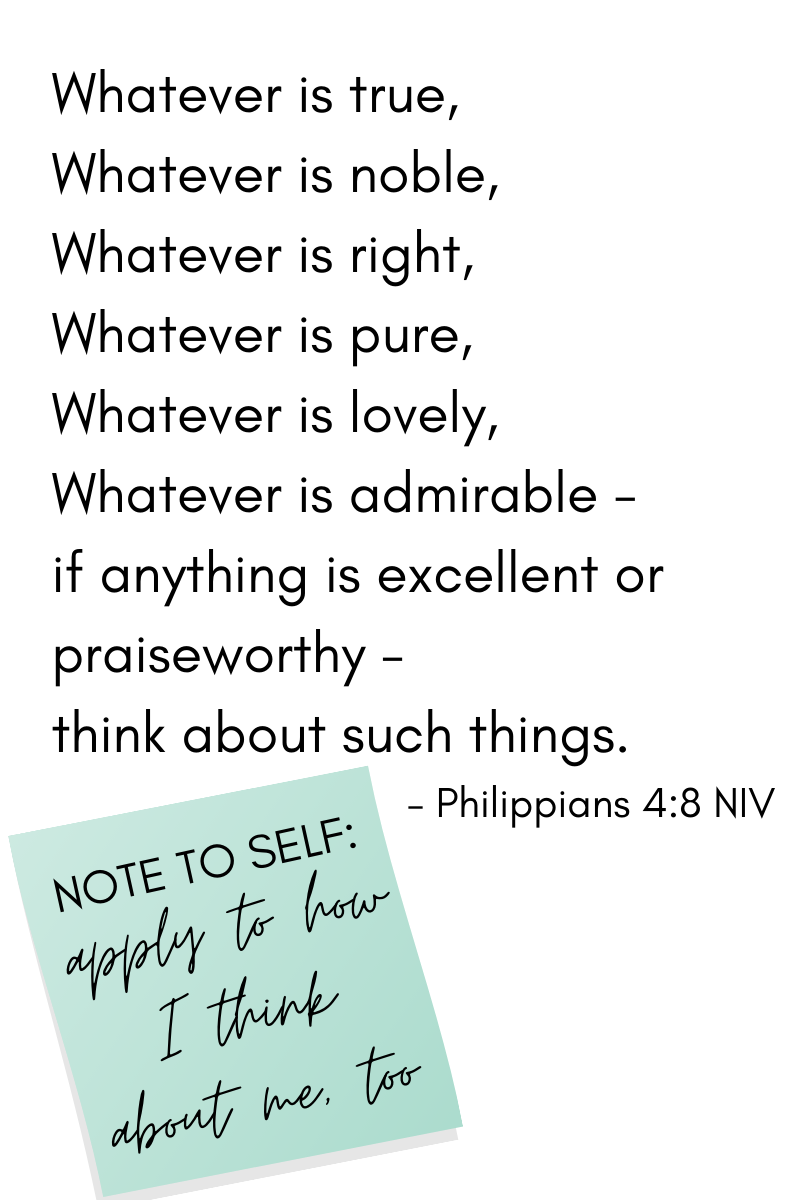
Text: Philippians 4:8

Finally, do we have control over our thoughts?

Yes! “…we take captive every thought and make it obedient to Christ,” (2 Corinthians 10:5 NIV) and “do not worry” (Matthew 6:25-34 NIV). These scriptures and more suggest that we can choose how and what we think.

Scientific research also backs up the power of the mind. Like this article from Harvard Health, which talks about the placebo effect, and how much it can improve physical conditions. Also, we can actually change the wiring that affects our perspective. Finally, we can choose to think differently about ourselves, which leads to a change in behavior and actions.

Here are some self-affirmations that you can consider in your own life:

Examples of self-affirmations - why we need self-affirmation - What You Make It blog

How about you?

How would contemplating these self-affirmations change your beliefs, behavior, and actions?

Photo Credit:

1 – My own

2 – Andrew Rodef on Unsplash

Bible verses via BibleGateway.com: Holy Bible, New International Version®, NIV® Copyright ©1973, 1978, 1984, 2011 by Biblica, Inc.® Used by permission. All rights reserved worldwide.

Examples of self-affirmations - why we need self-affirmation - What You Make It blog

Text: Daily Positive Affirmations for Women

Share this:

  • Click to share on Twitter (Opens in new window)
  • Click to share on Facebook (Opens in new window)
  • Click to share on Pinterest (Opens in new window)

Related

By: whatyoumakeit · In: inspiration

you’ll also love

baby boy
grove collaborative – worth it?
20 classic fall essentials and easy outfit ideas

Join the List

Stay up to date & receive the latest posts in your inbox.

Reader Interactions

Leave a Reply Cancel reply

Your email address will not be published. Required fields are marked *

This site uses Akismet to reduce spam. Learn how your comment data is processed.

Next Post >

3 unexpected steps to start tackling insecurity

Primary Sidebar

Meet Jenn

Meet Jenn
hello!

I’m Jenn - contemplative thinker, lover of words and the Word, wife and mom. You're invited to wonder, wander, and wrestle with God -- without guilt.

Read More

Connect

join the list

Join 5000+ readers of my newsletter, Make It Count! Get exclusive updates, bonus content, and more.

Featured Posts

She’s Not Your Enemy is Out Now!

5 Ways to Love God with Your Strength

7 ways to love God with your mind today

Categories

  • faith
  • marriage
  • motherhood
  • productivity
  • relationships
  • wellness

Search

Archives

Follow Along

@jennschultzauthor

And I really want you to hear this part: God is n And I really want you to hear this part:

God is not punitive like people can be.
And to take one verse out of context instead of lining it up with God’s character and heart for you is to miss the whole thing.

I just want you to know if that if the scriptures have felt (or been used) like weapons and your system has processed them that way—God isn’t demanding and disappointed like that. Not every verse is aimed at you or meant to be taken literally. 

Read in the context of who God is: compassionate, gracious, abounding in love and faithfulness. Read in the context of the whole Bible: God’s story of reconciliation and redemption and restoration of Creation. 

Maybe relax your shoulders, take a deep breath, and know you are loved and covered in grace.

#graceupongrace #faithjourney #deconstruction #spiritualformation #bibleversedaily
This trend, but about what happens when you ditch This trend, but about what happens when you ditch performance and perfectionism for grace-filled growth.

This is not a to-do list, by the way. Not a resume or test or a title. (Not, “you are now proclaimed holy”.)

These are, I’ve found, holy experiences that get revealed as you take steps along this faith journey. This is what it looks like when you’re settling in to the transformation that happens when you lean in to the Spirit, follow Jesus, and get to know God better. A settling of the soul. 

What kinda holy experiences have you encountered on your own unique journey with God?

#faithjourney #godwithus #deconstruction #spiritualformation #spiritled
Not to be dramatic, but… Everything changed when Not to be dramatic, but…
Everything changed when I started:

viewing stories of women in the scriptures with care and respect instead of making assumptions.

reading the Bible as God’s story, not morality tales about people. 

recognizing that God cares about our wholeness and wellbeing, not perfect performance or self-improvement.

seeking depth and God’s withness over easy answers. 

Does this feel like I’m reading your mail? (I’m not.) Stick around. Here we talk about rebuilding your faith and theology and Bible study without shame and shrinking ❤️

#deconstructingfaith #bibleverseoftheday #faithwalk #spiritualformation #godwithus
Not to be dramatic, but everything changed when I Not to be dramatic, but everything changed when I started…

…viewing stories of women in the scriptures with care and respect instead of making assumptions.

…reading the Bible as God’s story, not morality tales about people. 

…recognizing that God cares about our wholeness and wellbeing, not perfect performance or self-improvement.

…seeking depth and God’s withness over easy answers. 

Does this feel like I’m reading your mail? (I’m not.) Stick around. Here we talk about rebuilding your faith and theology and Bible study without shame and shrinking ❤️

#deconstruction #bibleversedaily #faithjourney #spiritualgrowth #jesusfollower
Everything changed when I started… …viewing s Everything changed when I started…

…viewing stories of women in the scriptures with care and respect instead of making assumptions.

…reading the Bible as God’s story, not morality tales about people. 

…recognizing that God cares about our wholeness and wellbeing, not perfect performance or self-improvement.

…seeking depth and God’s withness over easy answers. 

Is this resonating for you? Stick around. I’d love to chat more about rebuilding your faith and theology without shame and shrinking ❤️

#deconstructingfaith #spiritualformation #godslove #christianliving #biblestudymoments

Footer

Explore

  • Meet Jenn
  • Podcast
  • Resources

Info

  • About
  • Privacy Policy
  • Disclosure
  • Contact

stay in the know

Copyright © 2026 · Theme by 17th Avenue